My original travelling plan was to
head north after seeing the southern parts of Thailand, and so far I've successfully sticked to my itinerary. Most tourists or other backpackers without that much time as me just move straight ahead to Chiang Mai (the most popular city in the north) after visiting Bangkok. But hey, in fact there's a lot more to see in the north, for example places like
Kanchanaburi.
As a big
history and movie buff I always was fascinated by classic World War II flicks like
«A Bridge too Far» or
«Cross of Iron». Although these movies are more than 30 years old, they still seduce me with a certain charme that nowadays movies simply can't overcome. One of these all-time classics is
«The Bridge on the River Kwai» starring Sir Alec Guinness in his perfectly played role as Colonel Nicholson. I first saw that movie on TV when I was like 7 years old, and that motion picture still remains in my fondest memories as one the biggest cinematic classics ever produced. I mean there was splendid theatrical performance, an authentic historical context, real explosions (not like that CGI shit from nowadays) and probably
one of the best military tunes ever chosen for a movie theme.
So what has this to do with my trip? Well it's a known fact that the Bridge on the River Kwai actually
really exists, to be more precisely in
Kanchanaburi, 109km North West of Bangkok.
To enlighten all of you who never heard of that bridge or whatsoever: From
1942 to 1943 the Japanese Army constructed a
railway between Burma and Thailand to ensure their supplies by land to Burma (as before they only could use the dangerous maritime route to deliver supplies to the Japanese troops in Burma). Trouble was that the terrain in between was so unpredictable and hardly negotiable, that building a railway through all these jungles and rivers almost seemed impossible to specialists. But within
only one year and the
«help» of Prisoners of War from all parts of the British Commonwealth the Japanese finally were able to build such a railway, nowadays known as the
«Death Railway».
 |
| The Burma-Thailand railway, better known as Death Railway. |
The construction of the Death Railway earned its name from the
extremely harsh conditions that these Prisoners of War faced when building it, resulting in the death of over
16'000 P.O.W.s and another
90'000 Asian forced labourers. Throughout that 415km line the labourers were forced to construct hundreds railway cuttings and bridges, with the most famous one being the
Bridge on the River Kwai. So let us compare the
present reality, the
past and the
movie fiction of that iconic bridge.
 |
| The bridge on the river Kwai as seen today |
 |
| Still intact... |
 |
| ... and accessible. |
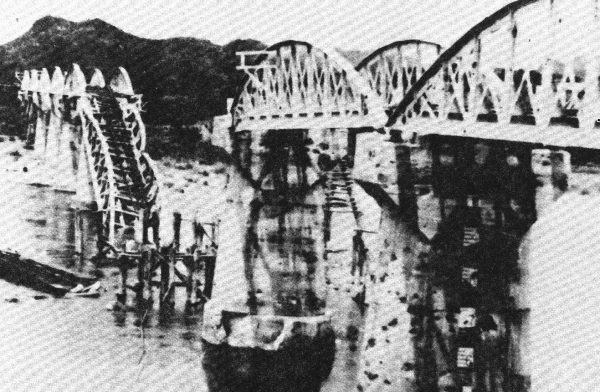
That steel bridge is still the same one that the P.O.W.s constructed
over 70 years ago, and nowadays serves as an iconic touristic sightseeing monument. It's noteworthy that Allied bombers
bombed that very bridge in 1944 (contrary to the common belief that there was an Allied commando unit who blew up the bridge just like in the movie). Later the bridge was rebuilt and sold to the Thai government, that still operates it up to today.
 |
| An aerial photo of the steel bridge (the bottom one)... |
 |
| ...that got bombed in 1944. |
As you may see in the aerial photo above, there was in fact another
wooden bridge 300m downstream, that served as a temporary supply bridge in the event that the steel bridge would be damaged. Some sources claim that this wooden bridge was bombed and rebuilt for several times, but it seems that one day it actually got completely destroyed by heavy floodings and that it was never rebuilt again. Today there is no trace of that bridge or whatsoever. So it seems like that wooden bridge served as an inspiration for the one from the before-mentioned movie
«The Bridge on the River Kwai», which was spectacularly blown up at the end of the film.
 |
| Sir Alec Guinness and Sessue Hayakawa in front... |
 |
| ... of the fictional bridge on the river Kwai. |
The whole stay at that location proved to be a
very fascinating experience for me as there were lots of
museums and historical sites to visit. Partly I got a completely new viewpoint at the whole topic and I'm thankful to finally have witnessed the «real thing».
Let's take a look on a few more things I went to see:
 |
| The main train station of Kanchanaburi |
 |
| A better view on the river Kwai |
 |
| A recreated P.O.W. barrack at... |
 |
| ... the JEATH musem. |
 |
| The Japanese Memorial Monument |
 |
| One of two war cemeteries in Kanchanaburi |
That
Japanese Memorial Monument above is actually really interesting: It was built by the Japanese
during WWII
to commemorate the P.O.W.s that worked and died on the Death Railway!
According to some sources the Japanese honor codex was one of the main
reason the Japanese actually built this shrine for their own Prisoners
of War! Pretty ironic, isn't it? This monument also can be seen in the
upper left
corner of the before-mentioned aerial photo.
 |
View from the Tham Kra Sae Bridge which is
still in its original state since WWII. |
 |
| Because most of these trestle bridges were destroyed during the war, it represents a very unique structure of the remaining Death Railway! |
|
|
|
|
|
|
| | | | | | | | | | | |
 |
| ... quite impressive too! |
 |
| The landscape around Kanchanaburi was actually... |
Another 80km North West of Kanchanaburi, high in the
Tenasserim Hills, lies also one of the most infamous construction site of the Death Railway called the
«Hellfire Pass». That railway section earned its reputation from the enormous
railway cuttings the labourers had to chisel through huge rock segments. It was one of the most tragic sections of the railway as most labourer fatalities actually occurred from working on the Hellfire Pass. On the former site now stands a
memorial museum that partly was funded by the Australian government (note that many former P.O.W.s were actually Australian). It was a
very professionally arranged museum and absolutely worth the visit. Besides of an
indoor exhibition it was of course also
possible to walk along the actual Hellfire Pass, where many men died over 70 years ago.
 |
| Japanese occupation money |
 |
| Inside the museum, in front a diorama of the Death Railway |
 |
| A secret foxhole radio that P.O.Ws used to receive news from BBC |
 |
| Common P.O.W. working tools |
While the
museum was great of course, there was
something that really annoyed me and almost spoiled my day. In the rear part of the museum was a small cinema section where graphic pictures (both photos and sketches) of mistreated prisoners of war were shown. Many P.O.W.s suffered from cholera, malnutrition, malaria, dysentry and other illnesses or were simply beaten to death.
Of course I had no problem with the photos themselves, but there was this huge group of
American swag teenies who just were
laughing at those pictures, while
making one hell of a noise without interruption or any respect at all. Good for them that they simply walked away after a few moments, but this incindent clearly made losing some
faith in nowadays humanity. I mean there's even
no common sense in that.
 |
| Really? Is such stuff funny to look at? Seriously?! |
However, I decided to move on to the original railway sections of the Hellfire Pass. The museum commitee made a very good job in preserving the railway cuttings and the walking trail through it.
 |
| Nature is trying to get back its territory... |
 |
| There still are railway fragments all the way up |
 |
| Some other tools like this cart were put to display |
 |
| One of the many rock cuttings of the Hellfire Pass |
 |
| A memorial stone the Australians set up |
 |
| One of these railway cuttings back then in WWII |
 |
| Because the railway cuttings were creepily illuminated in the night, this place earned its nick name «Hellfire Pass». |
 |
| Earlier a trestle bridge stood here, now there's just rubble |
 |
| Near the end of the trail |
 |
| An original Japanese train wagon |
 |
| ... of horrors from bygone times. Note the remembrance poppies. |
 |
| On that trail many historic artifacts still witness... |
Of course I also went to see no-WWII related stuff, like the Mueang Singh Temple Ruins. These ruins were part of a bigger Khmer temple city a few kilometers away from Kanchanaburi. From an architectural point of view you can actually compare it with the more famous Angkor Wat in Cambodia.
 |
| The main temple ruins of Mueang Sing |
 |
| And what fruits bears this tree? |
 |
| Sadly no Durians, but Jackfruits. |
 |
| Even more amazing at sunset... |
 |
| The ruins were actually deserted, nobody around. |
 |
| The ruins are still in perfect condition! |
 |
| Near the ruins we find some burial sites of former settlers |
 |
| Simply an amazing place! |
To round things up I also went to visit the kitschy
Tiger Temple of Kanchanaburi. It's in fact a Buddhist temple which holds quite a lot of tigers and other animals.
 |
| This Tiger sculpture welcomes the tourists at the gate |
 |
| And what's there to see? Tigers of course. |
 |
| ... it's actually the temple monks who look after the tigers. |
 |
| Along with professional staff... |
Although it may look like the animals are chained all the day long for the tourists only, I guess it's
still better than it looks like. While the tigers are only chained for about 3-4 hours a day, most of the time they stay in open air compounds that surprisingly remind me of the
Bear Park in Berne in terms of dimensions and facilities. The tigers also get lots of exercise by staff who train them.
However, I just realized
how long it takes to write
a single blog post, and there's still to write about
Ayutthaya, Sukhothai and
Chiang Mai (where I'm at the moment). I'll try to be brief next time. :)